
Specialty testing for space
Space weather is not just a cloudy day
The space environment is famously brutal, all the more so when taking into account upper atmosphere effects and long duration activities. Space operators need to know how long their missions can survive taking into account the effect of atomic oxygen (AO) and vacuum ultraviolet (VUV).
SpaceRig is proud to partner with Dr. Natale Ianno, who has built up a wealth of capabilities in material surface testing for exposure to the harshest elements of space. Please contact us today for help for your VLEO mission or your long duration high orbit mission!

About Dr. Ianno
Decades of atomic oxygen research and testing
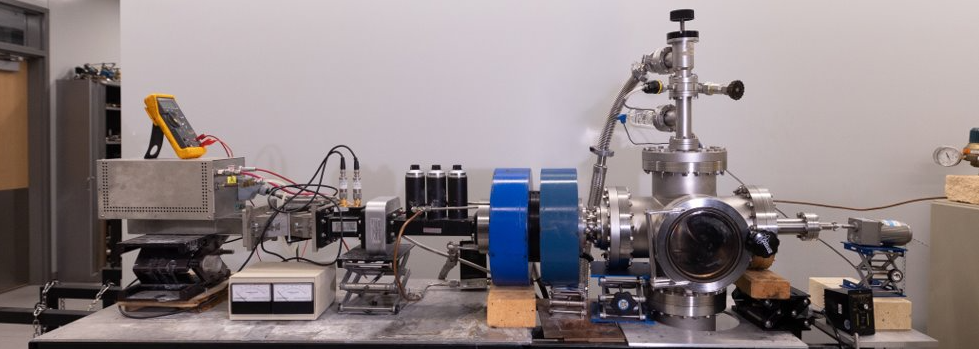
Dr. Natale (Ned) Ianno has been involved in atomic oxygen work beginning in the middle 1980’s with NASA where he was involved in utilizing spectroscopic to monitor atomic oxygen effects on materials in real time via spectroscopic ellipsometry. This lead to identifying and mitigating contamination effects in atomic oxygen systems. In the early 2000’s Dr. Ianno began development of an ECR based atomic oxygen system that is fully characterized with respect to atomic flux density, kinetic energy, ion content and VUV intensity.
Samples are illuminated by a standard 1 sun AMO solar simulator with a minimum wavelength of 300nm, in addition deuterium lamps provide VUV radiation where the these lamps are calibrated to provide 1 sun AMO intensity in the spectral range.
This system can expose materials as well as solar cell coupons with real time monitoring of the solar electrical characteristics. Finally he has developed a unique system capable of providing the optical constants (n index of refraction and α absorption coefficient) of photofixed films derived from the outgassing of any encapsulate material or material that outgasses. In addition, deposition rates which can be used to determine the activation energy of the photofixing process can also be measured.

Atomic Oxygen (AO) Services
SpaceRig offers atomic oxygen exposure testing, effectively simulating the environment of very low earth orbits (VLEO) and beyond. This exposure testing is increasingly needed for high performance Earth imaging and orbital maneuver applications. Manufacturers and developers are able to conduct qualification campaigns with low turnaround time and in a flexible and cost-effective manner.
AO Operating Features

Operating range
Temperature range of 0°C to +300°C
Atomic oxygen flux up to 10¹⁶ atoms/cm²·s at 3–5 eV

Operations
Facilities are designed to accommodate small materials coupons
Exposure testing and qualification campaigns for VLEO and LEO simulation via Electron Cyclotron Resonance (ECR) plasma.

Operating volume
Up to 8" diameter coupon
Long duration exposure to UV in vacuum can cause significant degradation in spacecraft hardware performance. Understanding of risks especially in high orbits (MEO, GEO, lunar) over long durations (5 years and up) require VUV testing.

Vacuum Ultraviolet (VUV) testing
Long duration exposure to UV in vacuum can cause significant degradation in spacecraft hardware performance. Understanding of risks especially in high orbits (MEO, GEO, lunar) over long durations (5 years and up) require VUV testing.
Manufacturers and developers are able to conduct VUV qualification campaigns with low turnaround time and in a flexible and cost-effective manner, including in conjunction with VLEO testing.
VUV Operating Features
Operating volume
8 inch area for one sun
Multi suns over a smaller area

Operating range
165-1800 nm
1 sun intensity (VUV + AM0 Spectrum)

Standards
<2×10⁻⁷ Torr, monitored with a Residual Gas Analyzer (RGA)
Supports AIAA S-112A-2003 exposure standards
Long duration exposure to UV in vacuum can cause significant degradation in spacecraft hardware performance. Understanding of risks especially in high orbits (MEO, GEO, lunar) over long durations (5 years and up) require VUV testing.